
When CeramicSpeed phased out PFAS from its ball bearings, sustainability did not come at the expense of performance. On the contrary, the transition led to lower friction, new markets and a stronger competitive position.
PFAS-free ball bearings strengthen CeramicSpeed’s market position
A groundbreaking new material with lower friction than Teflon has not only enabled CeramicSpeed to eliminate PFAS from its ball bearings – it has also opened the door to new markets and created a unique competitive position.
From the food industry to high-end bicycles
For years, CeramicSpeed has supplied high-performance ball bearings for cycling, motorsports and industrial applications. The company’s bearings are renowned for their ability to operate at speeds of up to 40,000 revolutions per minute, combining extremely low friction with long service life.
One of the company’s specialised product lines is its SLT (Solid Lubricant Technology) bearings. Unlike traditional bearings, SLT bearings integrate the lubricant directly into the bearing structure. Instead of oil or grease that must be reapplied, the bearings contain a plastic matrix with microscopic pores that absorb oil when heated. During operation, the oil is gradually released, providing maintenance-free lubrication.
However, achieving the right balance is critical.
“If the oil is released too quickly, excess oil accumulates outside the bearing and service life is reduced. If it is retained too tightly, there is insufficient lubrication,” explains Lina Søbjerg Madsen, IPR specialist and chemist at CeramicSpeed.
Proactive phase-out of PFAS
Although there was no regulatory requirement at the time, CeramicSpeed made an early strategic decision to phase out PFAS – including Teflon (PTFE) – from its products. The ambition was to combine sustainability with technological innovation.
“We are very committed to using chemicals that are as environmentally responsible and non-harmful as possible,” says Lina Søbjerg Madsen. “Even without legislative pressure, we saw an opportunity to stay ahead of future regulation.”
The challenge, however, was substantial: how could a material with friction properties comparable to Teflon be replaced without compromising performance?
Systematic collaboration leads to breakthrough
After several unsuccessful attempts to identify a suitable alternative, CeramicSpeed initiated an MUDP-supported collaboration with Danish Technological Institute. The partnership combined CeramicSpeed’s deep product knowledge with the institute’s expertise in materials technology.
“We had explored alternatives on our own, but realised we needed a more systematic approach,” says Lina Søbjerg Madsen. “Together with Danish Technological Institute, we were able to define precise performance requirements, while they contributed in-depth materials expertise.”
The development followed a structured and methodical process. First, a joint requirements specification was established. Danish Technological Institute then identified 18 potential materials, eight of which were selected for testing. Ultimately, the most promising candidate was implemented in production.
“This process reflects how we typically develop new alternatives,” says Peter Nørby from Danish Technological Institute. “When working with PFAS substitution, it is essential to clarify what the company actually needs – in other words, which material properties are critical for the product’s functionality.”
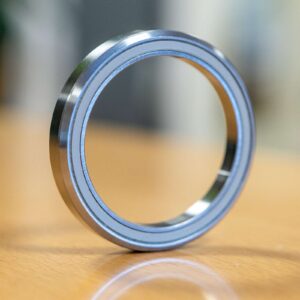
The PFAS-free bearing from CeramicSpeed
Less friction – greater potential
The real breakthrough came when the new PFAS-free material not only matched the performance of Teflon, but significantly surpassed it.
“We achieved up to 30% lower friction compared to PTFE,” says Lina Søbjerg Madsen. “That was completely unexpected when we started the project.”
This result fundamentally changed the potential applications of the technology. SLT bearings, previously used primarily in the food industry, could now also meet the demanding requirements of high-end bicycles – where minimal friction and low maintenance are decisive factors.
Unique technology creates competitive advantage
With the new material, CeramicSpeed has developed a proprietary technology that has significantly strengthened its market position. The bearings are now used in high-performance bicycle components for premium bicycles priced above 100,000 Danish kroner.
“We are currently the only company able to manufacture these bearings for bicycles,” says Lina Søbjerg Madsen. “Manufacturers who have tested them have returned with very positive feedback and a clear interest in implementing them in their products.”
The new bearings offer both extended service life and significantly reduced maintenance. As a result, CeramicSpeed now offers a lifetime warranty on selected products. The green transition has therefore delivered not only environmental benefits, but also direct business value.
Key learnings: innovation takes time – and collaboration
The project generated several important insights for CeramicSpeed. First, long-held assumptions were challenged.
“We discovered that our understanding of how friction reduction worked in the bearings was not entirely correct, which opened up new material options,” says Lina Søbjerg Madsen.
The project also highlighted that PFAS substitution does not have a universal solution. Each application requires its own technology assessment and material study.
Finally, product development proved more time-consuming than anticipated.
“Replacing PFAS is one thing. Understanding how a new raw material affects the entire product is another,” she explains. “We ended up redesigning the entire manufacturing process, and it took four years to reach our goal.”
Throughout the journey, collaboration with Danish Technological Institute was essential.
“The partnership gave us access to specialised knowledge and a systematic approach that we simply could not have achieved on our own.”
A sustainable and strong future
Following the successful phase-out of PFAS in its SLT bearings, CeramicSpeed is now looking ahead to new opportunities. Several bicycle manufacturers have already tested and approved the new bearings for upcoming models.
“We have created a product that is not only more sustainable, but also performs better than its predecessor,” concludes Lina Søbjerg Madsen. “This clearly demonstrates that sustainable innovation can be a direct driver of business development and new market opportunities.”